

ESTATE PLANNING
Chattanooga Estate Planning Attorney
Estate planning doesn't have to be confusing. We'll answer your questions, explain your options, and help you build a plan that's right for your family.
Frustrated and overwhelmed, Cathy shut the lid of her laptop.
"Now I'm more confused than I was before," she lamented to her husband, Greg, who was still knee-deep in an article explaining revocable versus irrevocable trusts.
Do these questions sound familiar?

The questions they'd searched on Google had only led to more questions.
✓ What happens if I'm unable to make decisions for myself?
✓ Do I need a power of attorney?
✓ What should I include in my will?
✓ Do I need a will or a trust?
✓ What happens to our children if something happens to us?
Greg looked up from his screen.
"I thought we just needed a simple will," he admitted. "Now I'm not so sure."
They knew they wanted to protect their family. But the best way to do it? That was the hard part.

Click Play to View VideoYou Don't Have to Figure It Out Alone Estate planning shouldn't be overwhelming
That's when Cathy found Resolutions Law Firm.
During their free consultation, the attorneys answered every question in plain English and took the time to understand what mattered most to Greg and Cathy—including protecting their youngest daughter with special needs. Instead of recommending a one-size-fits-all solution, they created a plan built specifically for their family's goals.
Greg smiled for the first time that afternoon.
"So...we don't need that expensive irrevocable trust after all for our situation?"
For the first time in weeks, Greg and Cathy weren't wondering if they were making the right decisions.
They knew they were.
*Greg and Cathy’s names have been
changed for privacy.

If you've found yourself asking the same questions Greg and Cathy did, we'd love to help.
Schedule a free, 30-minute consultation with one of our experienced estate planning attorneys, and we'll answer your questions, explain your options, and help you build a plan that's right for your family.

ON A PERSONAL NOTEDuring the COVID-19 pandemic, our attorney Darren Kennedy faced the loss of his own father. Having prepared his father's will years prior, Darren thought the process of transferring assets to his mother would be straightforward. However, when his mother suffered a stroke shortly before his father's passing, the situation became far more complicated. This deeply personal experience highlighted for Darren how even carefully prepared estate plans can fall short when life takes unexpected turns, underscoring the need for adaptable and comprehensive legal strategies.
Read his full story here.
Learn moreFrequently Asked Questions
-
A will is a legal document that specifies how your assets will be distributed upon your death, whereas a trust is a legal entity that holds assets for the benefit of specific individuals. Trusts can be effective during your lifetime, allowing for management of assets, while wills take effect only after death. Trusts also help avoid probate, whereas wills typically go through the probate process.
-
To create a valid will, you must be of legal age and sound mind, and the will should be written, signed, and witnessed according to your state's laws. It typically includes your intentions for asset distribution, the appointment of an executor, and guardianship for minor children if applicable. It's advisable to consult with an attorney to ensure compliance with legal requirements.
-
Dying without a will means your assets will be distributed according to state intestacy laws, which may not align with your wishes. Typically, assets will go to your closest relatives, and the court will appoint an administrator to manage the estate. This can lead to disputes among family members and prolonged legal proceedings.
-
A living will (also known as an advance directive) allows you to document your wishes for medical treatment if you're unable to communicate them yourself. A healthcare power of attorney, also called a medical power of attorney, allows you to choose someone you trust to make healthcare decisions on your behalf when you cannot. Together, these documents help ensure your wishes are understood and your loved ones have guidance when it matters most.
-
Choose an executor who is trustworthy, organized, and capable of managing financial and legal matters. This person may or may not be an heir or a family member, but they should be someone who understands your wishes and is willing to take on the responsibilities involved in settling your estate. It's also wise to have a backup executor in case your primary choice is unable or unwilling to serve.
-
A revocable living trust is a legal arrangement that allows you to transfer assets into a trust during your lifetime, which can then be managed by a trustee for your benefit or the benefit of others. Unlike a will, a living trust does not go through probate upon your death, allowing for quicker and more private distribution of assets. Additionally, a living trust can provide management of assets if you become incapacitated.
-
An executor is a person designated in a will to manage and distribute the deceased's estate according to the will's provisions. The executor's duties include gathering assets, paying debts, and ensuring proper distribution. In contrast, an administrator is appointed by the court when there is no will, or the executor is unable or unwilling to serve. Administrators perform similar duties as executors but must follow state laws regarding intestate succession (distribution without a will).
-
Yes, one of the primary benefits of a trust is that it can help avoid probate. Assets held in a trust pass directly to beneficiaries without going through the probate process, saving time and potentially reducing legal fees. Establishing a trust can streamline the transfer of assets and maintain privacy regarding your estate.
-
Trusts offer several advantages, including avoiding probate, providing privacy, and potentially reducing estate taxes. They can also offer greater control over asset distribution and management, allowing you to set specific terms for how and when beneficiaries receive their inheritance. Some trusts can also protect assets from creditors and ensure that your wishes are followed, depending on the type of trust.
-
A power of attorney (POA) is a legal document that grants one person (the agent or attorney-in-fact) the authority to act on behalf of another person (the principal) in legal or financial matters. The powers granted can be broad or limited, depending on the terms outlined in the document. A POA can be used for various purposes, such as managing finances, making healthcare decisions, or handling real estate transactions. A comprehensive estate plan may also include a healthcare power of attorney, HIPAA authorization to help designated individuals access important medical information, and final disposition instructions to communicate your wishes regarding burial or cremation. Together, these documents help your loved ones make important decisions with greater clarity and confidence.
-
A durable power of attorney is a specific type of POA that remains effective even if the principal becomes incapacitated or unable to make decisions. This ensures that the agent can continue to manage the principal's affairs without interruption. The durability feature is crucial for planning for situations where the principal may not be able to communicate their wishes.
-
Yes, you can and should review and update your estate plan regularly, especially after major life changes such as marriage, divorce, or the birth of a child. Changes in financial circumstances or laws may also necessitate updates. Most estate planning documents can be amended or revoked as needed, but it's crucial to follow legal procedures to ensure validity.
-
You should review and potentially update your will or trust every few years or after significant life changes, such as marriage, divorce, the birth of children, or substantial changes in your financial situation. Regular reviews ensure that your estate plan aligns with your current wishes and the law. Consulting with an estate planning attorney can help determine when updates are necessary. Resolutions Law Firm offers complementary updates to your estate plan every 3 years, at no additional charge.
-
For parents with minor children, choosing who would care for them if something happened to you is one of the most important parts of estate planning. A Child Protection Plan allows you to document your wishes, nominate a trusted legal guardian, and help ensure your children are cared for by the people you choose. While a court ultimately determines legal guardianship, having a thoughtful plan in place can provide valuable guidance and peace of mind for your loved ones.
What Our Clients ARE SAYINGFeeling Overwhelmed in the Estate Planning Process?
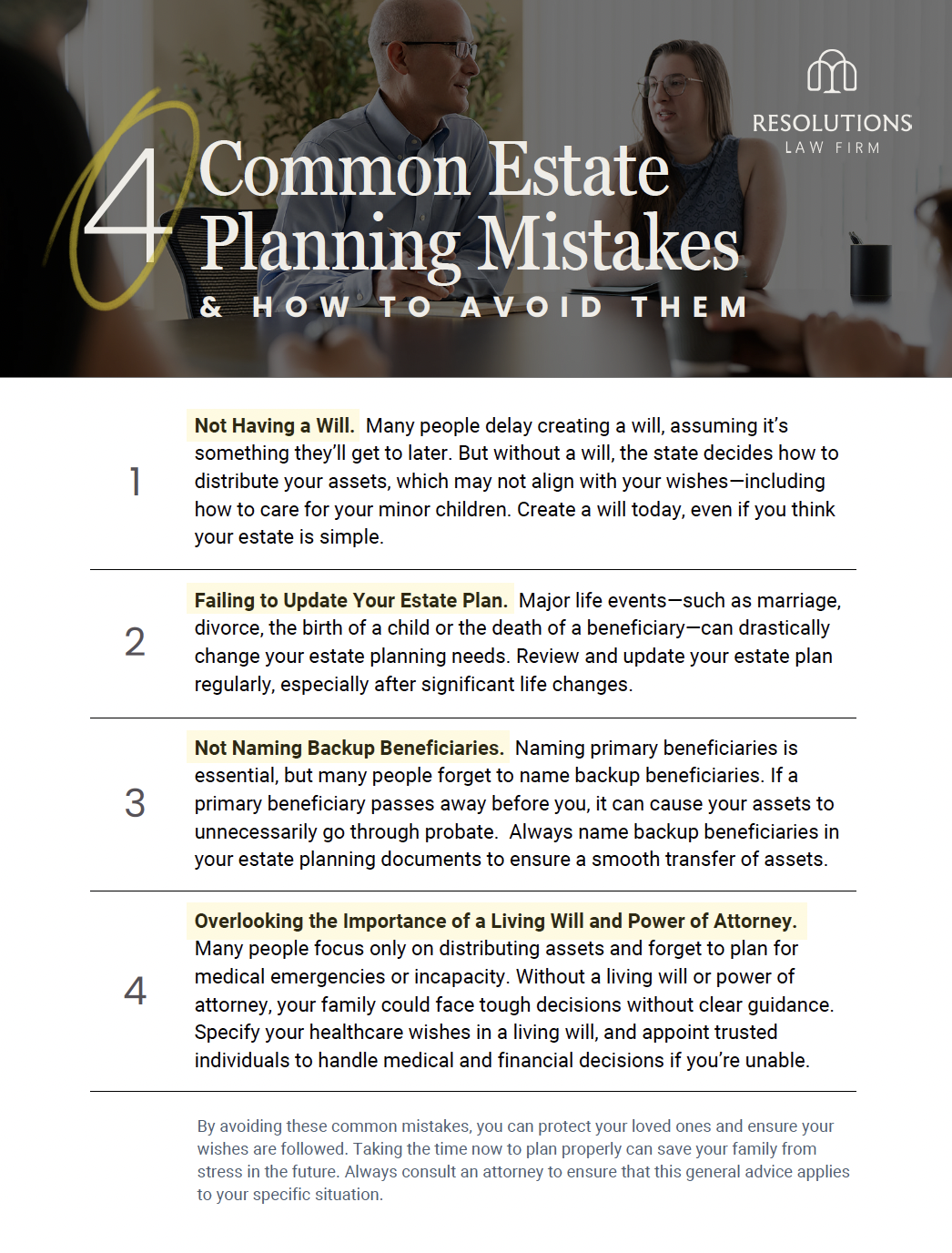
Download our FREE guide, 4 Common Estate Planning Mistakes and How to Avoid Them, to guide you in protecting your loved ones and safeguarding your assets.
NEXT STEPSWhen you’re facing an important legal decision, having the right guidance can make all the difference. Resolutions Law Firm combines nearly 20 years of experience with personalized service to help you protect what matters most—from your estate and property to your family’s future.